
Charleston County Circuit Court
South Carolina uses Circuit Court as its primary trial court of general jurisdiction. Charleston County is in the 9th Judicial Circuit with Berkeley County. Circuit Court has two named divisions: Court of Common Pleas for civil lawsuits and Court of General Sessions for criminal prosecutions. The South Carolina Judicial Branch Charleston County page lists the county courthouse, judicial circuit, Clerk of Court, Register of Deeds, judges, solicitor, public defender, public index records, and rosters.
The main Charleston County Circuit Court record counter is the Clerk of Court at 100 Broad Street, Suite 106. Julie J. Armstrong is the Clerk of Court. The Clerk maintains Common Pleas and General Sessions filings, while Family Court records are handled through the Clerk's Family Court counter in Suite 143. The Register of Deeds at 101 Meeting Street is nearby but handles land and recording records rather than case files.
Charleston County Courthouse
100 Broad Street
Charleston, SC 29401
Common Pleas and General Sessions: Suite 106
(843) 958-5000
9th Judicial Circuit
Charleston County and Berkeley County
Solicitor: Scarlett A. Wilson
Public Defender: Cameron Blazer
Charleston County Circuit Records
Common Pleas records include civil complaints, summonses, answers, motions, orders, judgments, dismissals, lis pendens, lower-court appeals, foreclosures referred to the Master-in-Equity, and financial or judgment information. General Sessions records include felony and higher-level criminal prosecutions, warrant numbers, indictments, charges, pleas, dispositions, sentences, bonds, hearings, and related action entries.
| Division | Record type | Main search path | Office |
|---|---|---|---|
| Common Pleas | Civil lawsuits, judgments, lis pendens, foreclosures, lower-court appeals | Public Index | Clerk of Court, Suite 106 |
| General Sessions | Felony and higher-level criminal prosecutions, charges, pleas, sentences | Public Index | Clerk of Court, Suite 106 |
| Family Court | Divorce, custody, support, domestic and juvenile matters | CourtPlus+ and Family Court search | Clerk of Court, Suite 143 |
| Master-in-Equity referral | Foreclosure and equity matters referred from Circuit Court | County court-info Master-in-Equity links | Master-in-Equity |
Search Charleston County Circuit Court
The Charleston County Public Index is the main online search channel for Circuit Court records. Common Pleas searches use Court Type = Circuit Court and Court Agency = Common Pleas. General Sessions searches use Court Type = Circuit Court and Court Agency = General Sessions. The official search tips state that a full case number can be entered alone when known.
- Accept the Public Index disclaimer.
- Select Circuit Court as the court type.
- Choose Common Pleas for civil records or General Sessions for criminal records.
- Enter the case number, party name, action type, date range, tax map number, judgment field, or lis pendens index as appropriate.
- Open the case number from the hit list, then review parties, actions, judgments, financials, associated cases, or document images where available.
Common Pleas example format is 2012CP1000254. General Sessions direct indictment example format is 2012GS1012345. The Public Index disclaimer says the online search is not the official record, and official records remain in the responsible offices.
Charleston County Circuit Judges
The South Carolina Judicial Branch courthouse page lists resident Circuit Court judges using Charleston County Judicial Center offices. Captured judge-office listings include The Hon. Deadra L. Jefferson at 100 Broad Street, The Hon. Jennifer B. McCoy at Suite 348, The Hon. Thomas J. Rode at Suite 439, and The Hon. Roger M. Young, Sr. at Suite 368. Judge assignments, chambers, rosters, and calendars should be checked through current state court rosters before a hearing or records-counter visit.
| Court or office | Type | Address | Phone |
|---|---|---|---|
| Charleston County Circuit Court | Common Pleas and General Sessions | 100 Broad Street, Suite 106, Charleston, SC 29401 | (843) 958-5000 |
| Family Court | Separate trial court with Clerk support | 100 Broad Street, Suite 143, Charleston, SC 29401 | (843) 958-4400 |
| Probate Court | Separate Probate Court | 100 Broad Street, Charleston, SC 29401 | (843) 958-5180 |
| Register of Deeds | Recording office, not case files | 101 Meeting Street, Suite 200, Charleston, SC 29401 | (843) 958-4800 |
Charleston County Lower Courts
Magistrate Courts and Municipal Courts are lower courts. Magistrate Courts handle traffic, misdemeanors punishable by a fine not exceeding $500 or jail not exceeding 30 days, preliminary hearings, bond settings, small claims, landlord-tenant matters, and related summary cases. Municipal Courts handle city or town ordinance cases, traffic tickets, and lower-level offenses inside municipal boundaries. Those records may not appear as Circuit Court cases unless appealed, indicted, transferred, or otherwise connected to Circuit Court.
| Circuit Court | Magistrate Court | Municipal Court | |
|---|---|---|---|
| Civil scope | Common Pleas civil lawsuits, judgments, lis pendens, foreclosure referrals | Small claims and landlord-tenant matters | Municipal civil matters when authorized by local law |
| Criminal scope | General Sessions felony and higher-level prosecutions | Summary offenses, bond, preliminary hearings, warrants | City ordinance, traffic, and lower-level municipal offenses |
| Record holder | Clerk of Court | Issuing Magistrate Court or county summary court system | Issuing Municipal Court |
| Appeal path | Appeals generally move to appellate courts | Some appeals go to Common Pleas | Some appeals go to Common Pleas |
Charleston County Circuit Case Flow
Criminal matters may start with arrest, warrant, citation, or lower-court bond and preliminary hearing activity before a General Sessions case is opened. Civil matters usually start when a complaint or petition is filed, followed by service, answer, motions, discovery, hearings, settlement, trial, judgment, or appeal. Lower-court cases may reach Common Pleas by appeal. Foreclosure and equity matters can be referred to the Master-in-Equity.
Criminal flow: Arrest or warrant › Magistrate bond or preliminary stage › General Sessions indictment or direct indictment › arraignment › pretrial motions › plea or trial › disposition › sentence › appeal.
Civil flow: Complaint or petition › service › answer › motions › discovery › mediation or hearing › trial or order › judgment › appeal or enforcement.
Federal Court Is Different
Charleston also has federal courts near the county courthouse, but federal records are not Charleston County Circuit Court records. The U.S. District Court for the District of South Carolina lists the U.S. District Courthouse at 85 Broad Street and the J. Waties Waring Judicial Center at 83 Meeting Street. Federal civil and criminal cases are searched through PACER/CM/ECF, while bankruptcy cases are searched through the U.S. Bankruptcy Court for the District of South Carolina.
The manifest captured the District of South Carolina homepage, which is useful only for distinguishing federal cases from Charleston County Circuit Court records.
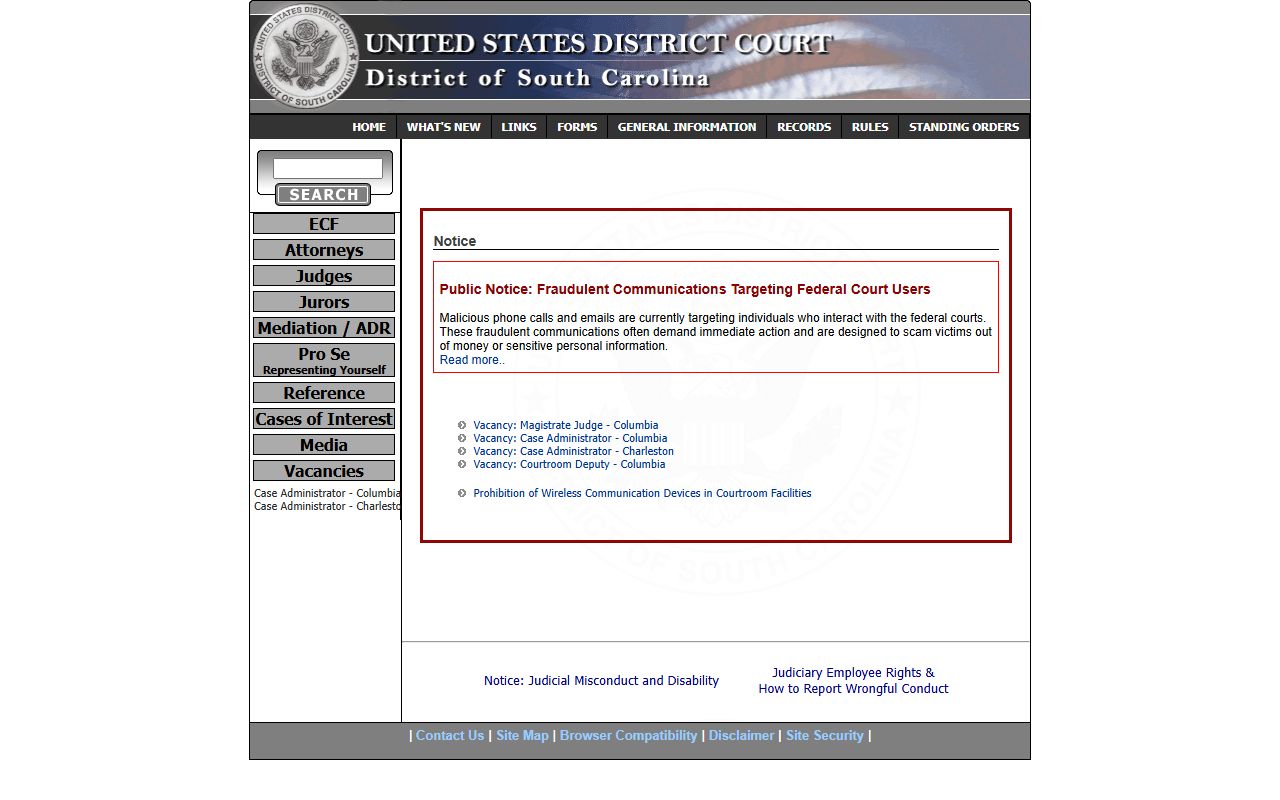
Use the state Public Index for Circuit Court, not the federal court homepage.
The federal Charleston court location page lists the nearby federal courthouse addresses and hours.
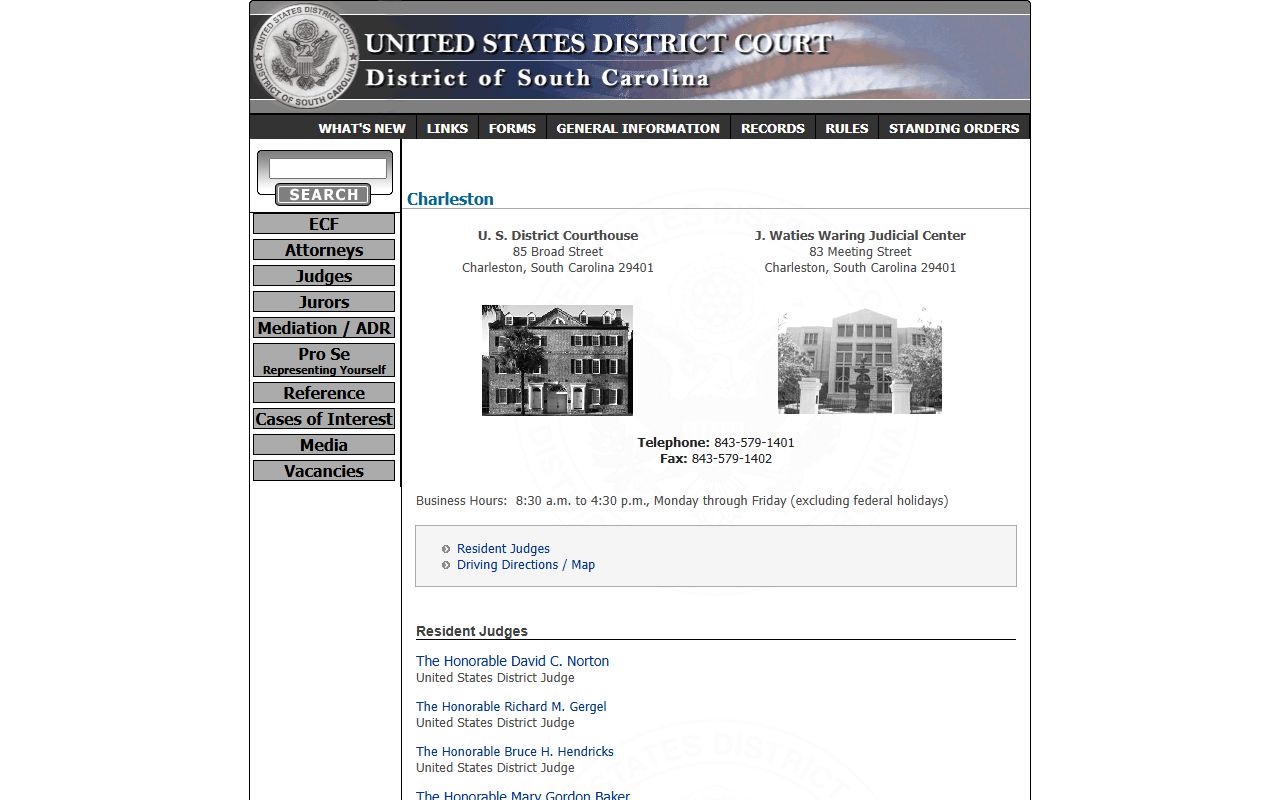
That location is close to 100 Broad Street, but it is a separate court system.
The PACER District of South Carolina lookup is the federal docket route for District Court cases.
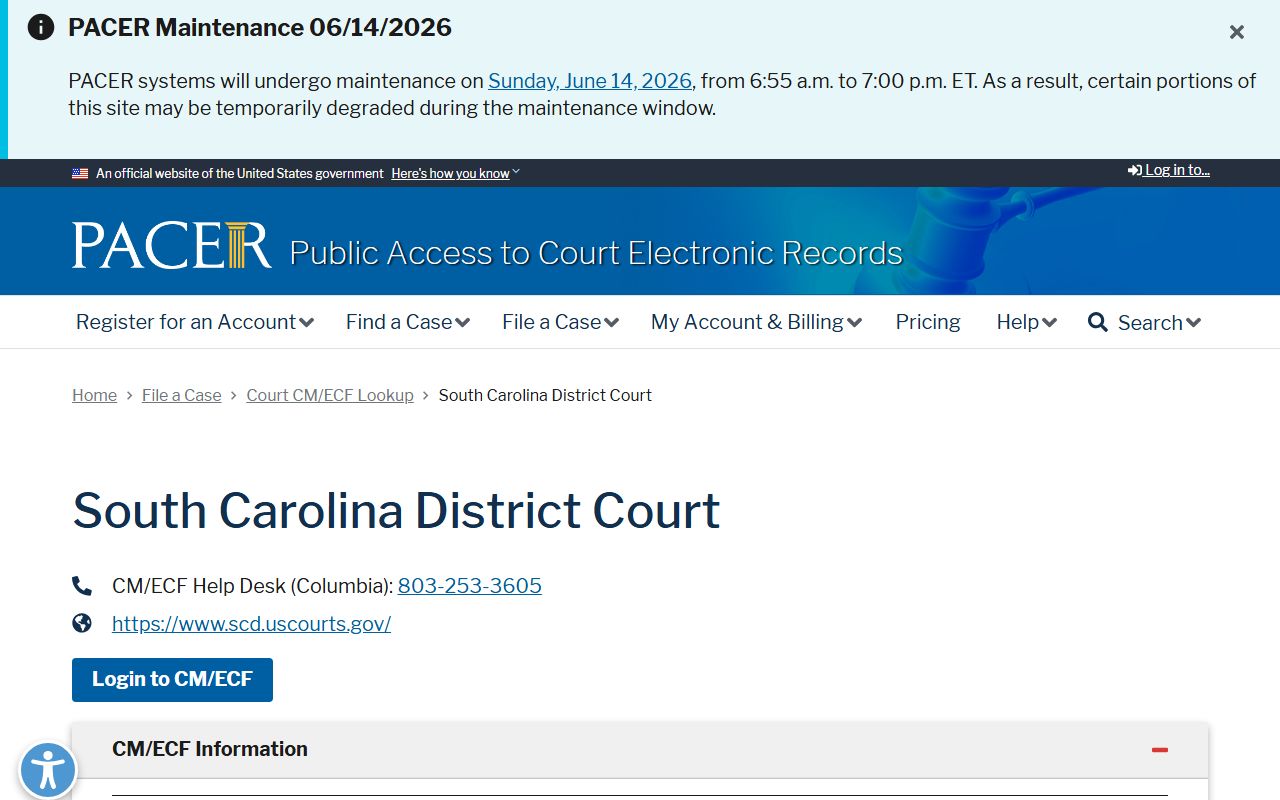
PACER records do not replace Clerk-held Common Pleas or General Sessions files.
The South Carolina Bankruptcy Court homepage is also separate from Charleston County Circuit Court.
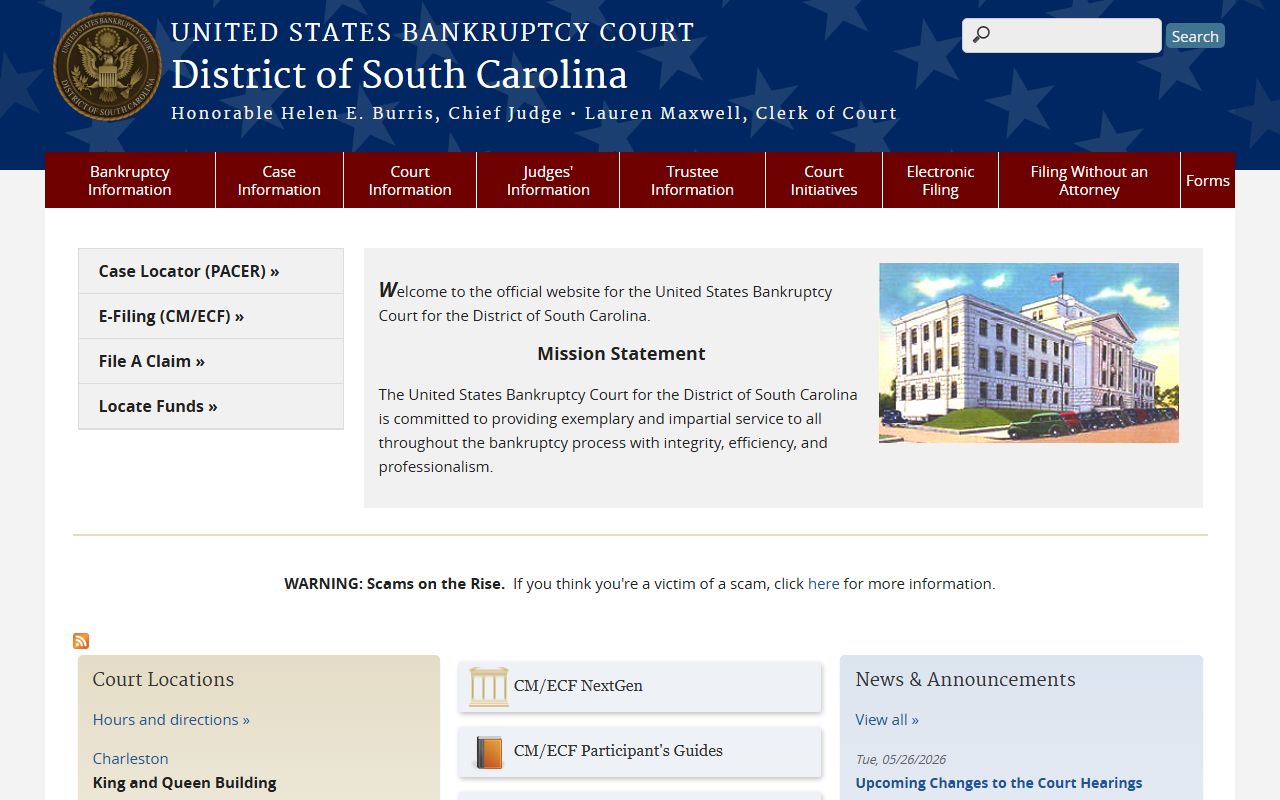
Bankruptcy records should not be confused with county civil judgments or foreclosure referrals.
The PACER South Carolina Bankruptcy Court lookup is used for federal bankruptcy docket access.
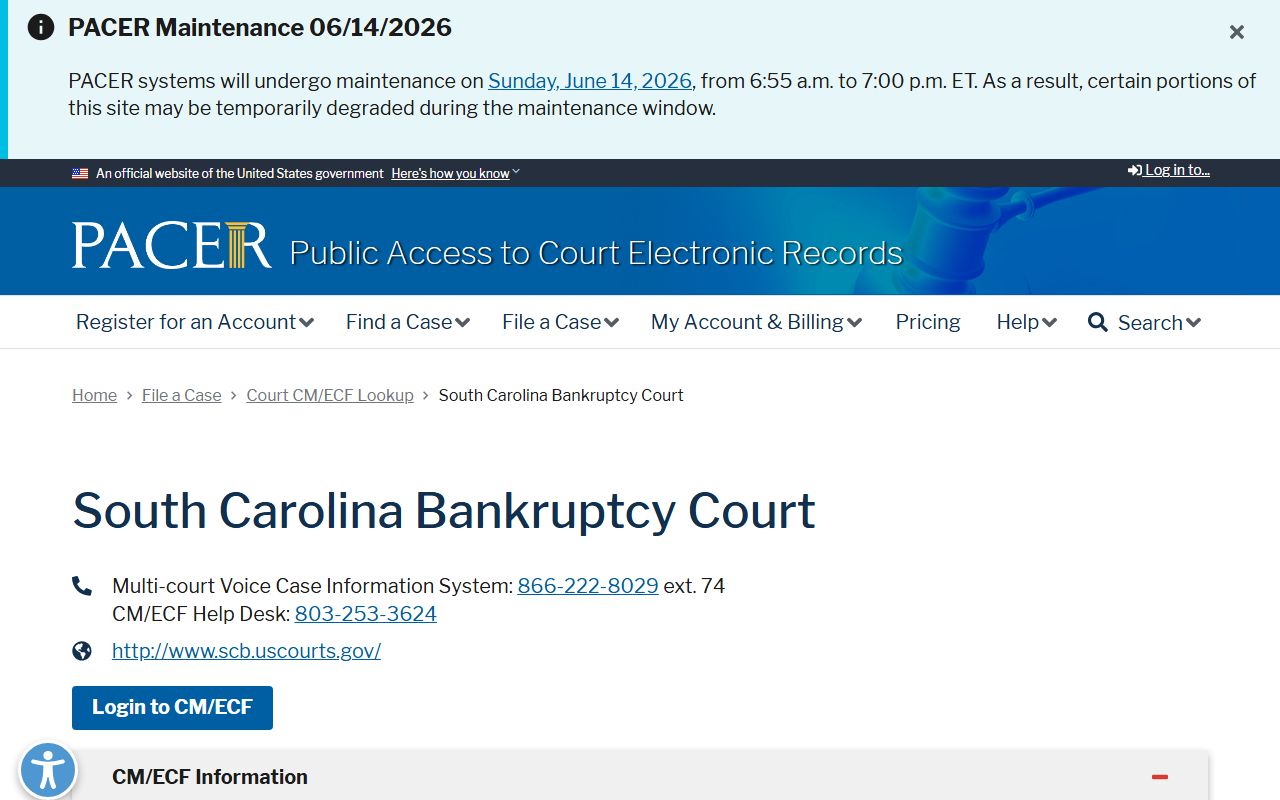
Use county Public Index searches when the matter is a Charleston County civil case rather than a bankruptcy case.
CourtListener can provide free access to some opinions or docket metadata, but it is not the official Charleston County Circuit Court record.
Official Charleston County Circuit Court records remain with the Clerk of Court and the county Public Index.