
Search Charleston County Court Records
The main local starting point is the Charleston County Public Index. It links Circuit Court records, General Sessions criminal cases, Common Pleas civil cases, Magistrate paths, search tips, and summary court dockets. The county also maintains a broader court-related services directory with links for CourtPlus, Day Book Search, traffic payments, probate searches, marriage records, Master-in-Equity foreclosure lists, jury service, and judge calendars.
The Public Index opens with a disclaimer. It says online data is not the official record, official records remain with the office that keeps them, and automated scraping is prohibited. It also states that home address data will not display on the public index for new and existing cases as of January 1, 2026. That privacy change affects what a searcher sees in Charleston County court records.
- Open the county Public Index and accept the disclaimer if you agree to its terms.
- Choose the court type and agency, such as Circuit Court and Common Pleas for civil records or General Sessions for criminal records.
- Search by case number when known, or use last name, business name, first name, party type, action type, and date fields.
- Open the case number from the hit list and review parties, actions, judgments, tax map, associated cases, financials, and document images when available.
- Contact the Clerk of Court or the issuing court for certified copies, sealed records, or records that do not appear online.
The Charleston County Government homepage is a useful source for county alerts before an in-person visit.
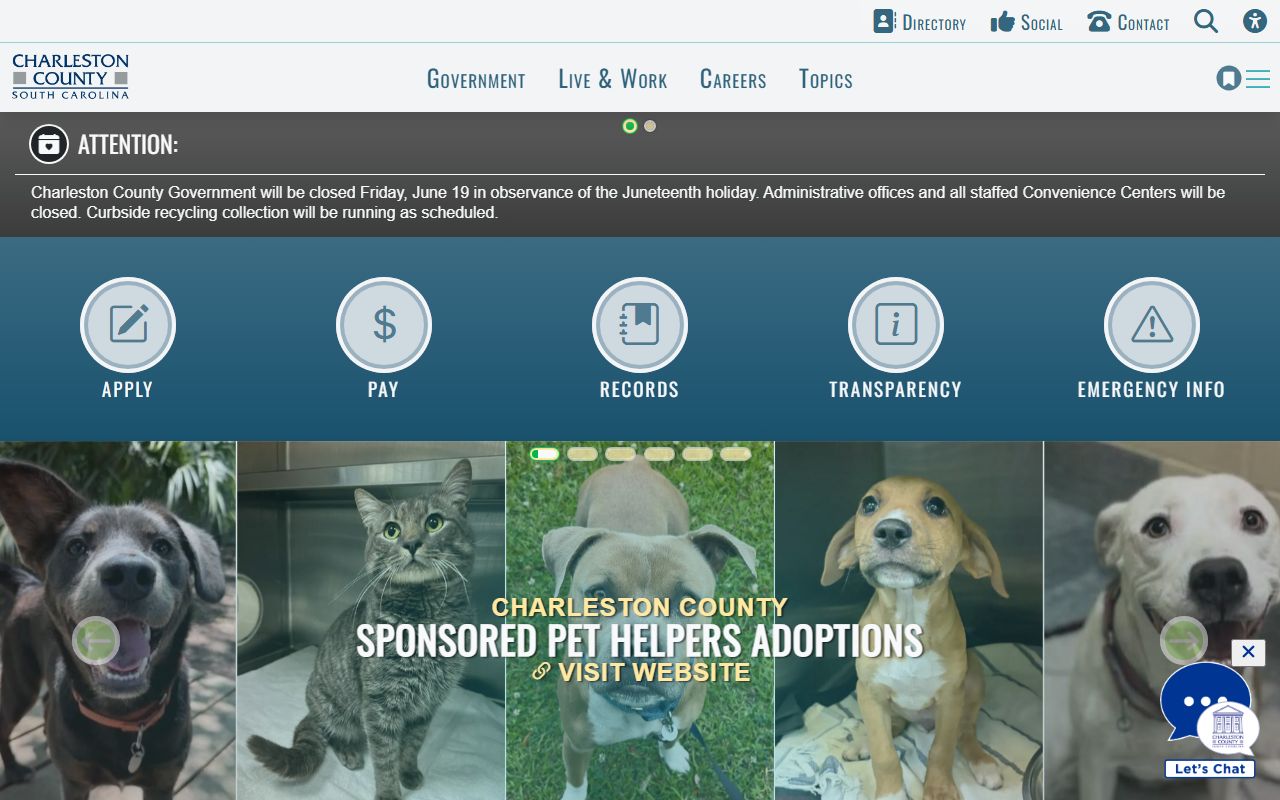
The county homepage connects records users to departments, alerts, online services, FOIA, and court-related offices before they choose a record channel.
Charleston County Court Search Fields
Charleston County court records searches work best when the search fields match the type of case. Common Pleas case numbers use the CP format shown in the Clerk search tips, while General Sessions records may use a GS case number, a warrant number, or a defendant name. Less information can return more results when spelling, punctuation, or business names vary.
| Field | Use | Format Notes |
|---|---|---|
| Court Type | Selects the court level | Use Circuit Court for Common Pleas and General Sessions. |
| Court Agency | Selects the division | Common Pleas is civil; General Sessions is criminal. |
| Case Number | Direct case lookup | Examples include 2012CP1000254 and 2012GS1012345 without dashes. |
| Last Name or Business | Party search | Avoid extra punctuation and do not start a business search with "the." |
| Action Type | Event search | Can find entries such as answer, summons and complaint, or order of dismissal. |
| Date Type | Date-range filter | Can narrow by filed, action, or disposed dates. |
| Index Search | Civil index filter | Includes lis pendens, judgments, judgment for, and judgment against. |
The South Carolina Judicial Branch is the statewide court gateway for case-record access, rosters, rules, and courthouse listings.
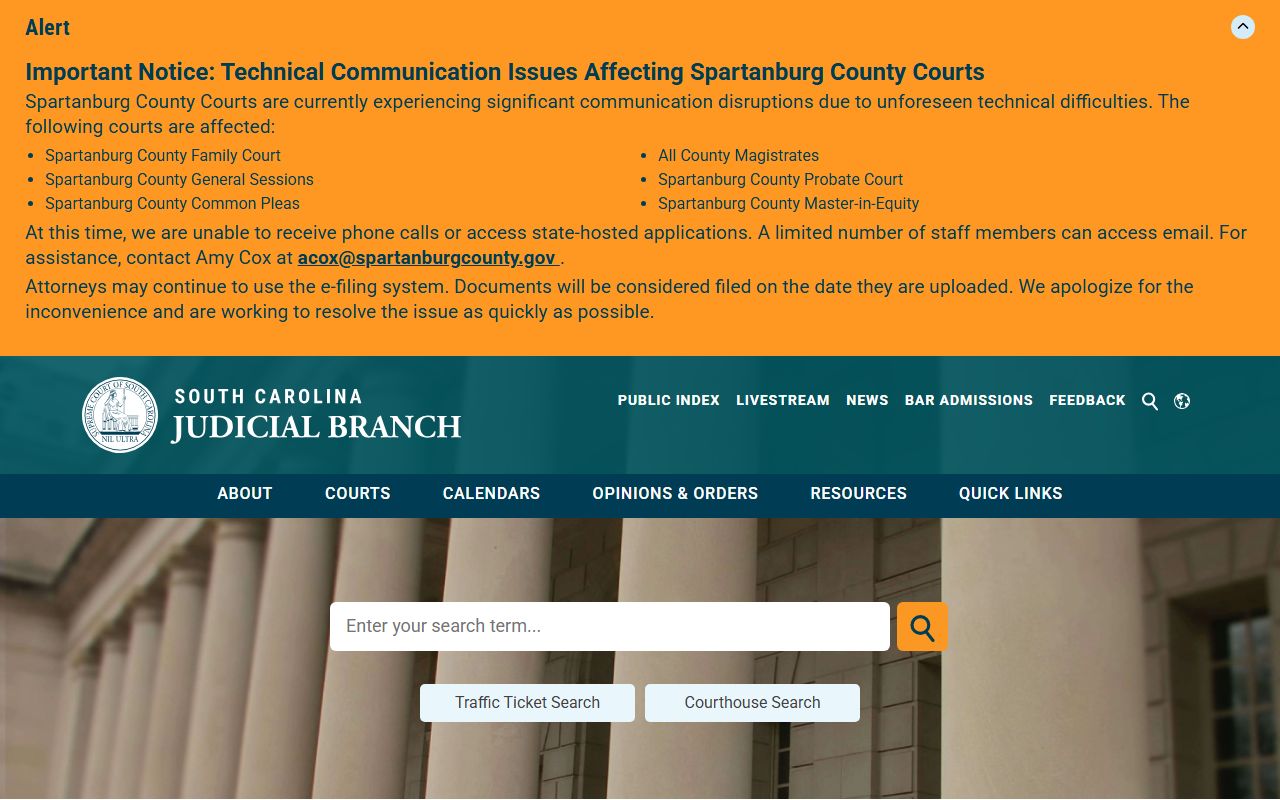
State judicial pages help confirm which Charleston County court or office holds a record before a request is sent.
Charleston County Court System
South Carolina uses a unified court system. Charleston County is in Judicial Circuit 9 with Berkeley County. Circuit Court is the primary trial court for serious civil and criminal matters, and it has two main divisions: Court of Common Pleas for civil cases and Court of General Sessions for criminal prosecutions. Family Court, Probate Court, Magistrate Court, Municipal Court, and Master-in-Equity records can sit outside a simple Circuit Court search.
That structure explains why one name search may not find every Charleston County court record. A felony case may be in General Sessions, a divorce may be in Family Court, an estate may be in Probate Court, a ticket may be in Magistrate or Municipal Court, and a foreclosure referral may appear through Master-in-Equity material tied to Common Pleas.
| Court or Office | Records It Handles | Common Access Route |
|---|---|---|
| Circuit Court, Common Pleas | Civil lawsuits, judgments, liens through cases, lis pendens, foreclosure referrals | Public Index and Clerk of Court |
| Circuit Court, General Sessions | Felony and higher-level criminal prosecutions | Public Index, Clerk of Court, Ninth Circuit Solicitor |
| Family Court | Divorce, custody, support, juvenile and domestic matters | Family Court Clerk and CourtPlus paths |
| Probate Court | Estates, wills, marriage licenses, guardianships, conservatorships | South Carolina Probate Search and Probate Court |
| Magistrate and Municipal Courts | Traffic, summary criminal, warrants, bonds, small claims, ordinances | Summary court dockets, issuing court, payment portal |
Charleston County Courthouse Contacts
The main county court building is the Charleston County Courthouse and Judicial Center at 100 Broad Street in downtown Charleston. The Clerk of Court handles Common Pleas and General Sessions in Suite 106 and Family Court records in Suite 143. Probate Court marriage services are also in the building, while the Register of Deeds is nearby at 101 Meeting Street and handles land records rather than court case files.
Clerk of Court
100 Broad Street, Suite 106
Charleston, SC 29401
(843) 958-5000
Family Court
100 Broad Street, Suite 143
Charleston, SC 29401
(843) 958-4400
The state courthouse listing for Charleston County confirms the circuit, courthouse address, clerk, Register of Deeds, judges, solicitor, public defender, case records, and rosters.
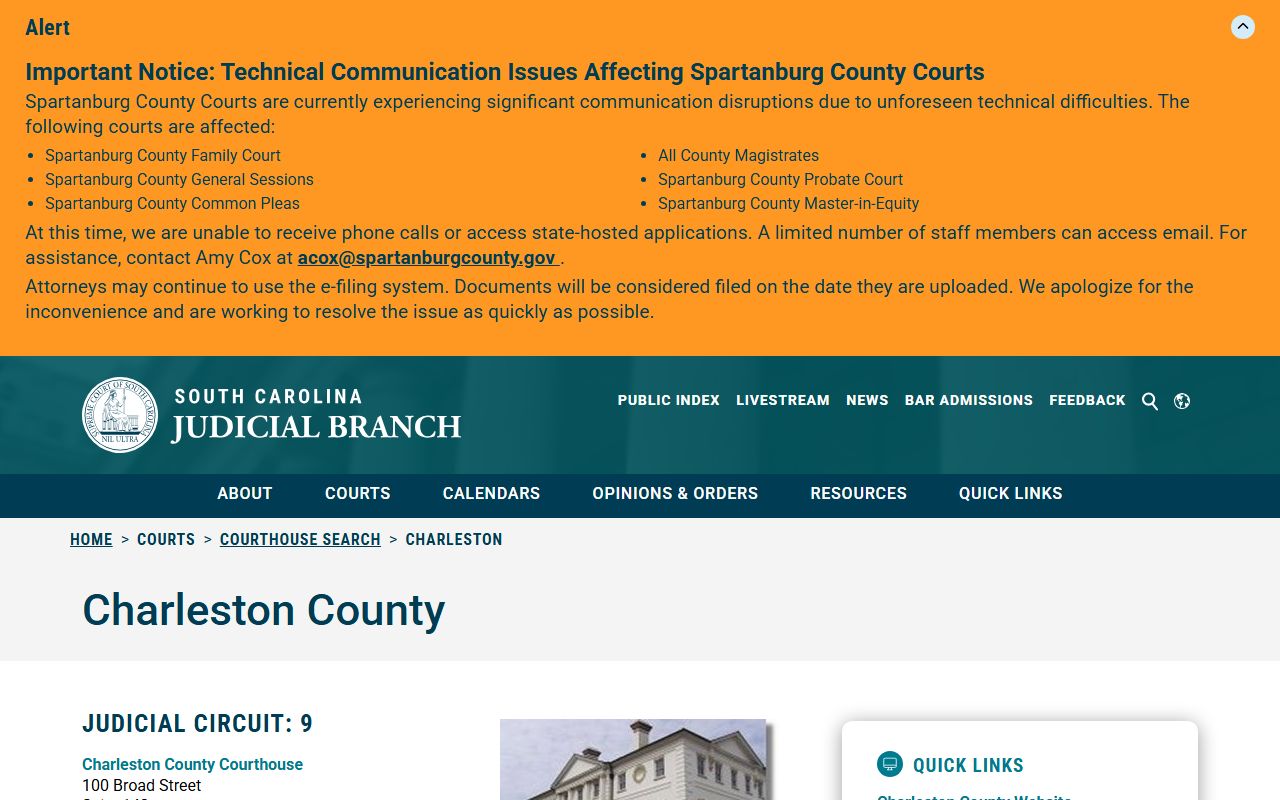
The state courthouse listing is a strong cross-check when a record seeker needs the judge roster or the right Charleston County court office.
Charleston County Court Record Types
Court records in Charleston County include civil complaints, summonses, motions, orders, judgments, General Sessions charges, indictments, pleas, dispositions, sentences, Family Court divorce records, probate estate files, marriage licenses, traffic citations, small claims, landlord-tenant cases, and lower-court criminal matters. Some records are public online, some require a clerk counter request, and some are restricted by statute or court order.
Use the record type to choose the route. Full criminal court records are not the same as booking records. Probate estate records are not kept by the Clerk of Court. Driver records are held by the SCDMV, not the traffic court. Federal cases in Charleston are searched through PACER and federal court systems rather than Charleston County Public Index.
- Docket
- A chronological list of filings, hearings, orders, and case events.
- Disposition
- The final outcome of a case or charge, such as dismissed, guilty, not guilty, or disposed.
- Lis pendens
- A notice that litigation may affect real property.
- Expungement
- A process that seals, removes, or destroys eligible arrest, charge, or conviction records.
Charleston County Public Access Rules
South Carolina public access is shaped by the South Carolina Freedom of Information Act, Rule 610 for judicial branch records, court privacy rules, and statutes that close specific record types. FOIA gives the public a right to inspect or copy public records unless an exemption or another law applies. Rule 610 governs requests for South Carolina Judicial Branch records and can deny requests when the information is already public online or includes confidential material.
Charleston County court records also have practical limits. The online Public Index is not the official record. Official copies come from the office that keeps the file. Protected identifiers can be redacted by written request, including Social Security numbers, driver's license numbers, state ID numbers, passport numbers, bank and card numbers, PINs, codes, and passwords. Juvenile records, termination-of-parental-rights records, sealed matters, expunged records, mental-health commitments, and many family details are not open like routine civil filings.
| Rule or Statute | Why It Matters |
|---|---|
| S.C. Code Section 30-4-30 | Creates the general right to inspect or receive public records unless restricted. |
| S.C. Code Section 30-4-40 | Lists exemptions for privacy, law enforcement, confidential data, and other limits. |
| Rule 610, SCACR | Controls judicial branch records requests outside normal case-search tools. |
| S.C. Code Section 63-19-2010 | Makes juvenile court records confidential except under limited access paths. |
| S.C. Code Section 17-22-910 | Places many criminal expungement applications with the circuit solicitor. |
The state FOIA statute page provides the core public-records framework for county records that are not ordinary court-case documents.
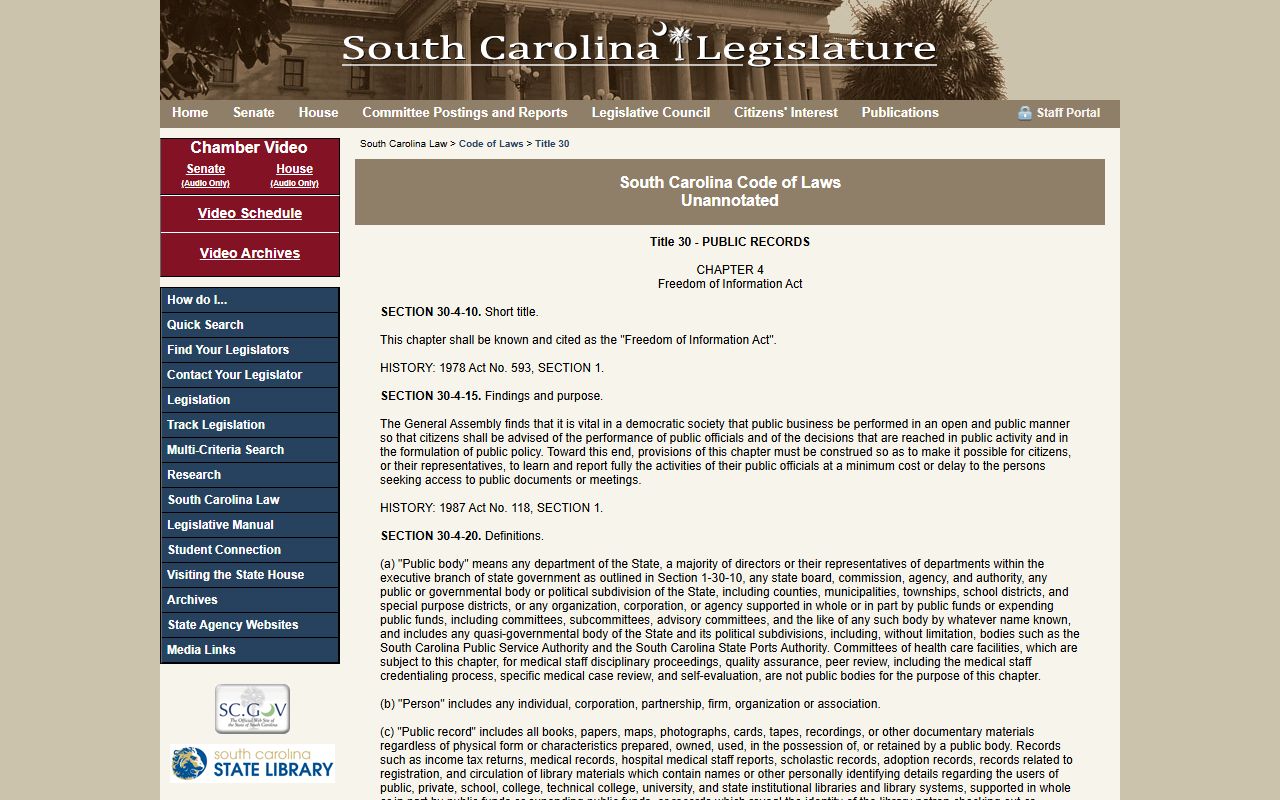
FOIA is useful for county agency records, while court case files usually begin with the court or clerk that maintains the record.
Charleston County Criminal Records
Charleston County criminal court records in General Sessions are prosecuted by the Ninth Circuit Solicitor and maintained by the Clerk of Court. A case file can show charges as filed, indictment or direct indictment, arraignment events, motions, plea, trial result, disposition, sentence, bond, financial entries, and related docket actions. The Solicitor also provides case-search, diversion, and expungement resources for Charleston and Berkeley Counties.
Arrest records and court charges require extra care. A jail booking may show an arrest and current custody status. A court charge record tracks the offense as it moves from warrant, citation, complaint, information, or indictment into court. The full criminal record later adds the case outcome. For eligible dismissed, diversion, or lower-court matters, the Ninth Circuit Solicitor and South Carolina Judicial Branch expungement pages explain the request path.
Charleston County Court Dockets
Court dockets are the case activity logs and scheduling records that show what has happened or what is set to happen in court. Charleston County records users may need the Public Index action tabs, Summary Court Dockets, SC Judicial Branch rosters, judge calendars, or the issuing Magistrate or Municipal Court. A docket is not always the full case file, but it often shows the fastest view of filings, hearings, orders, and disposition events.
The county court-info directory links official docket and roster resources.
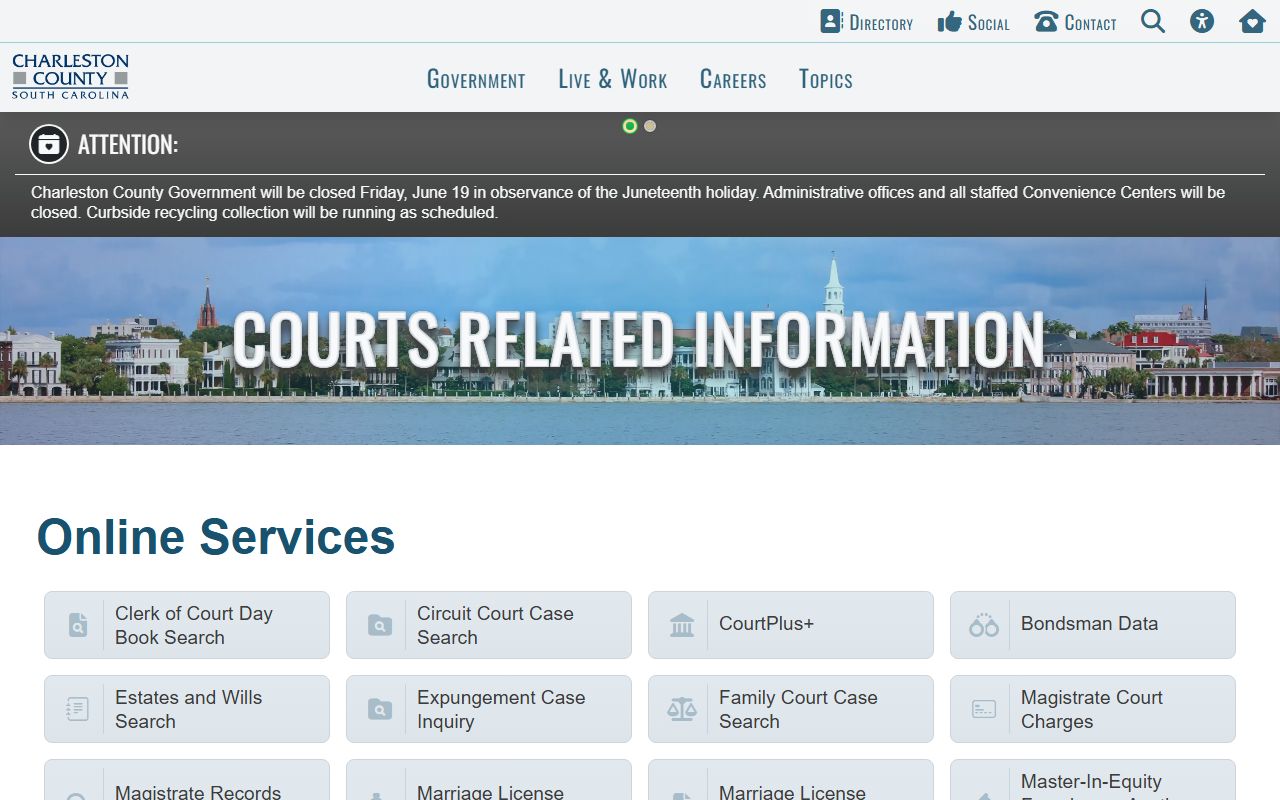
The directory is useful because Charleston County docket sources differ between Circuit, Family, Probate, Magistrate, Municipal, and Master-in-Equity matters.
Charleston County Warrants and Inmates
The Charleston County Sheriff's Office publishes an active warrant search and an inmate search for Sheriff Al Cannon Detention Center custody. The warrant page requires at least a last name and warns that online results are not confirmation that a warrant is active. The Sheriff says warrant status should be confirmed through the Sheriff's Office, the Warrants Unit, Consolidated Dispatch after hours, in person at Pinehaven Drive, or through the issuing court.
The inmate search can be searched by name, booking date, arrest date, sounds-like matching, inmate number, and past-booking option. County jail records are separate from SCDC state-prison records, BOP federal inmate records, and VINE custody notification. The Charleston Co Sheriffs Office app is documented as an official public-safety news, reporting, and tip channel, but the captured app listings do not prove an app-only inmate or warrant lookup.
Charleston County Traffic Records
Traffic court records may sit in Magistrate Court or Municipal Court depending on the issuing agency and location. The county online payment portal allows full credit-card payment for eligible citations after the disclaimer is accepted, but it warns that mandatory appearance charges still require court and no partial online payments are accepted. Payments must be made at least 48 hours before the scheduled court time and may take 72 hours to post, excluding weekends and holidays.
A traffic court record is different from a South Carolina driver record. The court record shows the citation, court, date, fine, appearance status, disposition, and bench-warrant processing. The SCDMV driver record shows license status, convictions reported to DMV, points, suspension, and driver history. Crash reports are another separate channel through SCDMV Form FR-50.
Charleston County Probate Records
Charleston County Probate Court handles estates, wills, guardianships, conservatorships, commitments, treatment courts, and marriage licenses. Marriage applications use the online South Carolina Probate Applications route, require identification and Social Security or alien-registration proof, carry a 24-hour waiting period, and are followed by emailed license delivery after processing. Certified marriage copies are ordered online through the Probate Court process.
Estate and will records are searched through South Carolina Probate Search for Charleston County. The search supports county selection, surrounding-county expansion, name fields, all-party search, case-name search, and an expandable gray plus on results. Probate result columns include case number, case name, party, type of case, filing date, county, appointment date, creditor claim due, and case status.
Federal Court Records in Charleston
Federal court records near Charleston County are not held by the county Clerk. The U.S. District Court for the District of South Carolina lists the federal courthouse at 85 Broad Street and the J. Waties Waring Judicial Center at 83 Meeting Street. Federal civil and criminal dockets are searched through PACER or CM/ECF. Bankruptcy records use the U.S. Bankruptcy Court for the District of South Carolina and the bankruptcy PACER system.
Federal custody is also separate. BOP records cover federal inmates from 1982 to present, while county pretrial custody is searched through the Charleston County inmate search. CourtListener can help with many opinions and some docket metadata, but it is not the official federal docket.
Charleston County Judicial Requests
When a Charleston County court record is not available through the Public Index, court counter, Probate Search, or the issuing court, the next route depends on the holder. Judicial branch records may use the Rule 610 request process. County agency records outside court case files may use Charleston County's FOIA portal. Law-enforcement records may also be limited by active-investigation and privacy exemptions.
South Carolina's Rule 610 request page explains the judicial branch process.
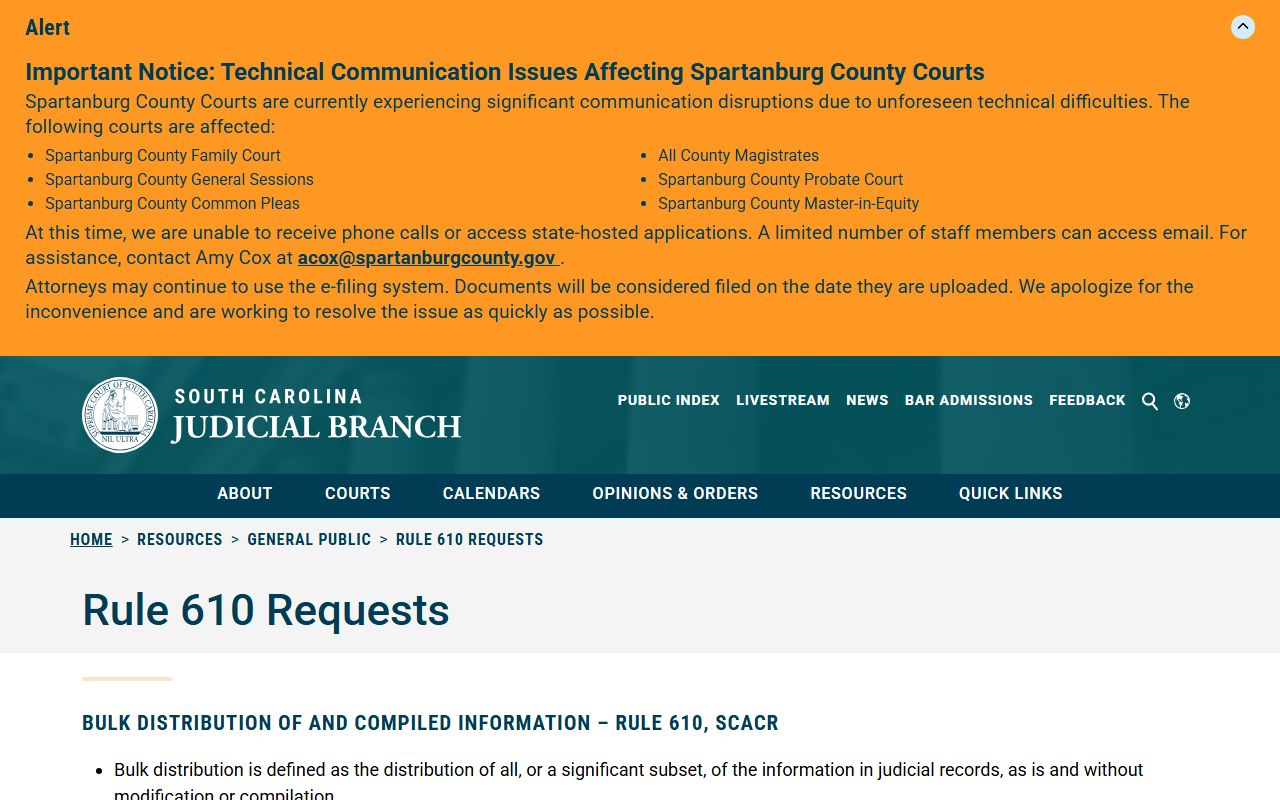
Rule 610 is most useful after the normal Charleston County court record portals and clerk counters have been checked.
Directions to Charleston County Court
The primary courthouse address for map routing is 100 Broad Street, Charleston, South Carolina 29401. It sits in the downtown legal district near Meeting Street, the Register of Deeds, the federal courthouse, and other public offices. Parking in the historic district may involve city garages, private lots, and metered spaces, so build in time for walking and court security on hearing, jury, or filing days.
Charleston County Judicial Center
100 Broad Street
Charleston, SC 29401
Clerk: (843) 958-5000
Family Court: (843) 958-4400
Register of Deeds
101 Meeting Street, Suite 200
Charleston, SC 29401
(843) 958-4800
Land and recording records
Charleston County Court Records FAQ
Are online Charleston County court records official? The Public Index says the online publication is provided as a public service and is not the official record. Official records remain in the office responsible for the file.
Where are divorce records? Divorce is a Family Court matter. The Charleston County Clerk of Court Family Court office at 100 Broad Street, Suite 143 handles the file and certified decree requests.
Where are estate records? Estate and will records are Probate Court records. Use the Charleston Probate estate and wills search, then contact Probate Court for certified copies or counter help.
Can a warrant search prove arrest authority? No. The Sheriff's warrant disclaimer says the public website is not confirmation that a warrant is active and is not probable cause for arrest.
Do traffic tickets appear on driver records? A traffic conviction may be reported to SCDMV and affect points or license status, but the court traffic record and the driver record are separate files.